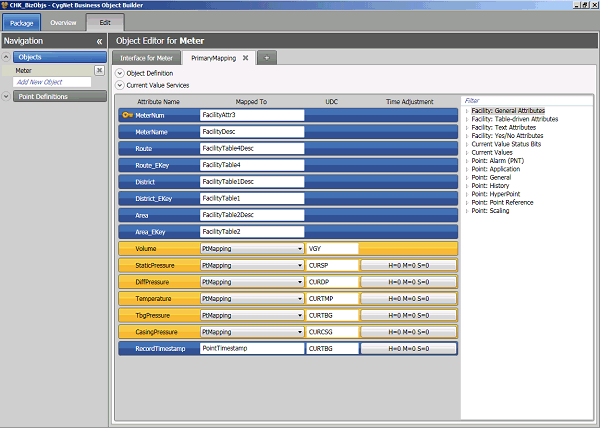
Once a Business Object Interface is created, you can create Business Object Mappings to map the interface attributes to data.
A Business Object Mapping allows translation between the Business Object Interface and the internal CygNet SCADA data model. It defines the mappings between a set of internal SCADA data attributes and their corresponding external enterprise data attributes, as declared in a specific Business Object Interface.
For each enabled Business Object Interface, the Enterprise Operations EIE must have one, or more, associated Business Object Mappings. Once a Business Object Mapping is associated with a Business Object Interface, the EIE is able to translate related data from the internal SCADA data model to the external enterprise data model.
The following sections provide additional information about Business Object Mappings.
Every simple attribute of the Business Object Interface can be mapped in the Business Object Mapping. Facility attributes or "flattened" point attributes can be mapped to simple attributes.
Every Business Object Mapping must have a Unique Key defined. The unique key defined in the Business Object Interface can be mapped to one or more Facility Attributes.
Note: Unique keys may not be mapped to flattened point attributes.
Object Interface Point Definition Attributes support mapping to the internal SCADA data model. The Object Mapping for a Point Definition includes:
A Business Object Mapping allows the administrator to "flatten" a point or real-time record attribute. This is an option allowing mapping of data from a point record to a simple attribute in appropriate circumstances.
Example
There is a simple attribute on a "Valve" business object interface called "ValvePosition" but there is no simple or facility attribute in the SCADA data model indicating the valve position. There is however a point attribute with the UDC "VALVEPOS" which could provide the data. This point can be "flattened" to map "VALVEPOS" to the "ValvePosition" simple attribute.

Elements of the Business Object Mapping interface include the following.
The Business Object Mapping must include a definition of the Business Object in terms of native CygNet constructs.
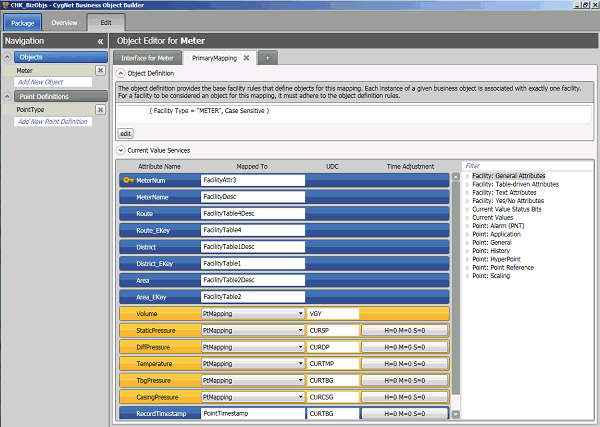
These parameters allow the Enterprise Operations EIE to evaluate the state of SCADA entities (facilities, points, etc.) before representing them as valid instances of a Business Object.
Example
A definition parameter on a "CompressorStation" object might assert that a "FacilityType" must equal "COMPSTAT" in order to be considered a valid "CompressorStation" object.
Only Services purposely added to the Business Object Interface are permitted to provide data for Enterprise Operations requests. Each Object Mapping is associated with specified Current Value Services. These Services are specified in the Current Value Services field of the Mapping page, as part of the Business Object Mapping. Services can be added in the format Site.Service.
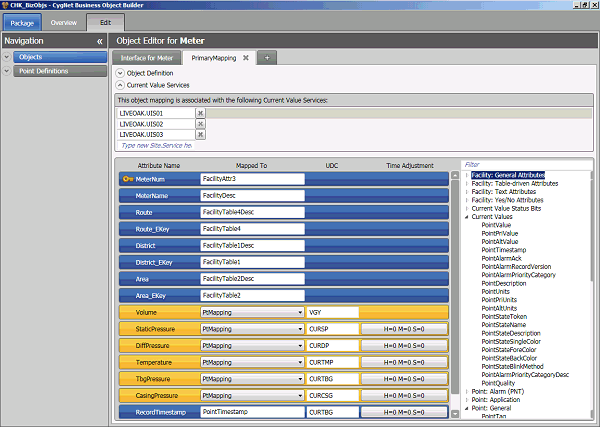
The Attribute Name is the name of the attribute in terms of the enterprise data model. Attributes are either Simple or Point Definition, which determines configuration options available for the mapping of the element.
The Mapped To field indicates the SCADA data model point definition which is mapped to the Business Object Interface attribute selected.
Every Point Definition element defined in the Business Object Interface must have an associated UDC specified in the Business Object Mapping .
Time Adjustment is optional and allows configuration of history rollups. Clicking on the attribute's button in the Time Adjustment column displays the Configure History Rollup dialog box.
Note: Time Adjustment is not an option for all attributes.
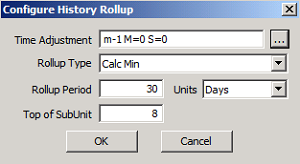
| Parameter | Description |
|---|---|
|
Time Adjustment |
Allows selection of Time Adjustments for configuration of History Rollups by browsing to Select Date and Time. Select Date and Time options are:
Note: If Relative Date/Time or Relative Day are used, the Current Time, Adjusted Time, and Relative Time will be displayed at the bottom of the dialog box, as configured by your selections. See Select Date and Time for more information. |
|
Rollup Type |
Allows selection of Rollup Type. Choices are: None, Calc Weighted Avg, Calc Mean, Calc Min, Calc Max, Calc Delta, Calc Last, Thin Median, Thin Last. See History Rollups for descriptions of Rollup Types. |
|
Rollup Period |
Allows selection of Rollup Period. Rollup Period refers to the quantity of specified Units in a specified period. Example To rollup 30 days, the Rollup Period is "30" and the rollup Units is “Days.” |
|
Units |
Allows selection of rollup Units. Choices are: None, Seconds, Minutes, Hours, Days. |
|
Top of SubUnit |
Allows selection of a Top of SubUnit offset from the normal date/time (generally midnight). This provides a method to allow for differences in start of day, time zone, or scheduling. Example If you are using a rollup period of 1 day, and your data day starts at 8:00 A.M. (instead of midnight), you can offset the period by entering an “8” in the Top of SubUnit field. Note: This field uses 24-hour time. |
Date and Time can be configured as Absolute Date/Time, Relative Date/Time, or Relative Day, as illustrated.
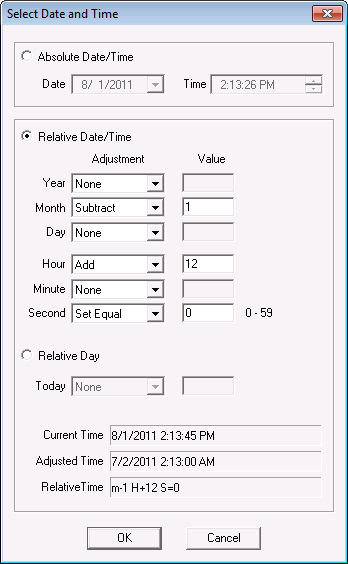
Business Object Mapping supports configuring a relative point-in-time (PIT) for Flattened Point Attributes, and for Point Definition Attributes. The relative offset supports days (d), hours (H), minutes (M), and seconds (S).
Example
A string element called "VolumeLastHour" could be mapped as follows.
Historical attributes can not be configured for point-in-time (PIT) time adjustments. For time t-n, an additional offset is necessary if there are mapped points in PIT mode, such as "LH" point.
Example
"LH" would become t-n-1.
Facility Filters can be applied to limit the amount of data shown. To apply a filter, click the Edit tab on the Object Definition dialog box. Options include Tree View and Text View.
See Using CygNet Filter Rules for a general discussion on using CygNet filter rules.
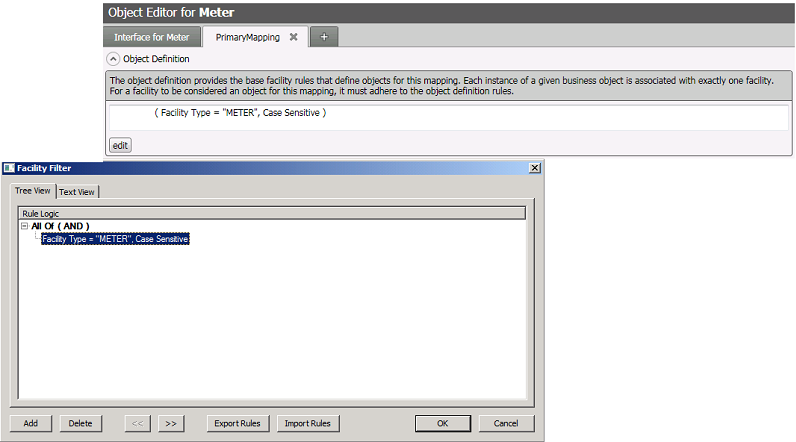
Rules can be added to or deleted from, and can be exported from or imported to, the Rule Logic in the Facility Filter dialog.
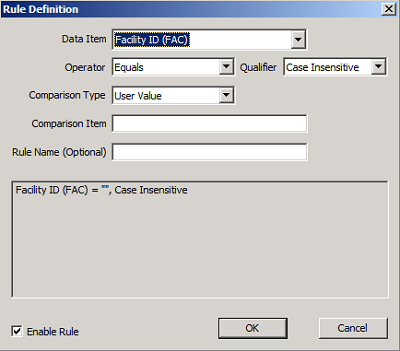
| Parameter | Description |
|---|---|
|
Data Item |
Allows selection of a Facility Attribute Data Item for the rule. |
|
Operator |
Allows selection of a rule Operator. Choices are: Equals, Greater Than, Greater Than or Equal, Less Than, Less Than or Equal, Not Equal. |
|
Qualifier |
Allows selection of a rule Qualifier. Choices are: Case Insensitive, Case Sensitive, Integer, Real Number, Timestamp. |
|
Comparison Type |
Allows selection of a rule Comparison Type. Choices are: Reference Attribute, User Value. |
|
Comparison Item |
|
|
Rule Name |
This parameter is optional. |
|
Enable Rule |
Allows selection/de-selection of the choice to Enable Rule. |
A drop-down menu of available SCADA data point definitions appears in the farthest right pane of the Mapping page. Double-clicking an element in this list selects it for mapping to the selected attribute, and causes it to populate the Mapped To field.
To Create a New Business Object Mapping
To Edit a Business Object Mapping
To Copy a Business Object Mapping
Copying a Business Object Mapping can be achieved by exporting the mapping with a new file name, and then importing the new file back into the mapping.
See File Import and Export Options for more information.
To Delete a Business Object Mapping
|
|
|

